Strategy automation
Translate defined signals into rules for proposed orders and exits. Ambiguous instructions are clarified with the client before configuration rather than guessed during a build.

Services
Strategy automation, testing, broker connections and monitoring are configured as one reviewable workflow.
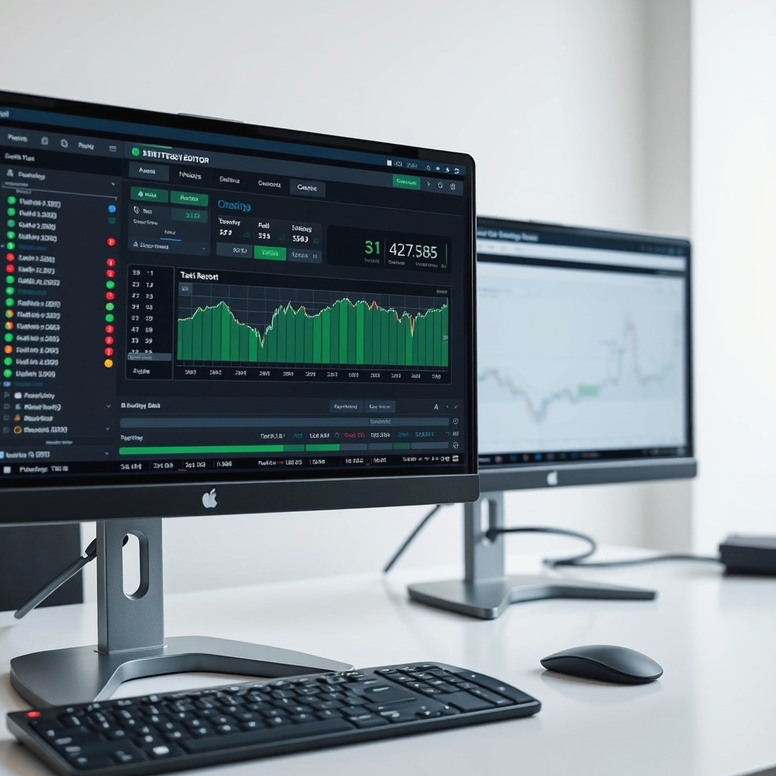
We turn a client's written strategy into configurable entry, exit and sizing rules, add exposure limits, and connect the workflow to a supported broker interface. A typical single-strategy setup takes two to four weeks after the rules and access requirements are agreed. We run historical tests with documented assumptions, check order behaviour in a non-live environment and set up monitoring for errors and pauses. At handover, the client receives configuration notes, test reports and a guided dashboard review.
Translate defined signals into rules for proposed orders and exits. Ambiguous instructions are clarified with the client before configuration rather than guessed during a build.
Run historical tests with visible date ranges, costs and assumptions. Results describe past model behaviour, not what a live account will achieve.
Configure position sizing, exposure ceilings and pause conditions. Each control is checked against example scenarios before a live connection is considered.
Check a supported broker interface, authentication flow and order responses. Available functions depend on the broker and the client's account permissions.
Show strategy status, order events, connection errors and alerts in one place so the client can review exceptions and stop execution when needed.
We start with a written description of the strategy, the instruments involved and the client's proposed limits. Where a rule cannot be expressed clearly enough to test, we identify the gap before building. The output is a scope document that separates strategy decisions supplied by the client from software behaviour we can configure and verify.
Historical tests use stated assumptions about data, costs and execution. We review sample trades and exceptions, not just an aggregate chart. A non-live broker check then confirms how the connection reports accepted, rejected and interrupted orders. These checks are useful for finding configuration problems, although live prices and execution can differ.
The dashboard makes current status and recent events visible. Alerts can flag connection problems, paused rules or orders that a limit blocks. We explain how to read these events and how to stop the workflow. The client remains responsible for supervising the strategy and deciding if or when it should run live.
Stroubdesign does not choose investments, manage client funds or make discretionary trades. We configure tools around rules you supply and discuss the technical consequences of those rules. A backtest is not a prediction: data quality, spreads, slippage, outages and changing market conditions can affect live behaviour. Broker availability and permissions may also limit an integration. If your strategy has not been defined, the first useful step is to write its conditions down, not to connect an account.
| Manual workflow | Configured automation | |
|---|---|---|
| Rule changes | Can be adapted immediately by the trader | Require a reviewed configuration change |
| Order timing | Depends on the trader being present | Depends on defined triggers and a working connection |
| Exposure checks | Trader checks each proposed position | Configured limits check proposed orders |
| Exceptions | Trader notices issues directly | Alerts and logs still need human review |

An initial discussion works best when you can share a plain-language description of your entry and exit conditions, the instruments you intend to trade and the limits you want enforced. Do not send passwords or account credentials through the contact form. We first check whether the rules are specific enough to configure and whether the proposed broker connection is supported. If either is uncertain, we explain the gap before suggesting a build.
Describe the rules and broker you have in mind; we can tell you what needs clarification.